
The Spirit of the South: The 2026 Melbourne Grand Prix.

The Grand Slam of Motorsport
From 5-8 March 2026, the world’s fastest drivers will descend once more upon Melbourne for the 2026 Australian Grand Prix, the opening race of a radically transformed Formula 1 season. The event marks not merely the start of a championship campaign, but the ignition of a new technological era.
The shift in mood is immediate. Only months earlier, engines echoed through the humid night of Marina Bay Street Circuit. Now, the paddock relocates to the wide skies of Victoria. Gone are the floodlights and tropical haze. In their place: autumn sunlight shimmering across Albert Park Lake, eucalyptus-scented air, and a city awakening to the sound of possibility.
In 2026, Melbourne does not just host a race. It opens the season. And in doing so, it sets the tone for everything that follows.
Arriving in Style: The LLC Experience
Grand Prix week transforms Melbourne. Helicopters skim the skyline, superyachts line the Yarra, and St Kilda Road becomes a procession of polished metal and anticipation. For those who view Formula 1 as a theatre of precision, arrival is part of the performance.
London Luxury Chauffeuring, known globally as LLC, has become the discreet partner of choice for VIP guests, team affiliates and corporate hosts seeking an entrance as smooth as a perfectly executed lap around Albert Park.
A Fleet Worthy of the Grid
From the imperious presence of the Rolls-Royce Phantom to the refined authority of the Mercedes-Maybach S-Class, LLC’s fleet offers sanctuary from the roar of the new-generation V6 hybrids. Climate-controlled cabins, privacy glass and handcrafted interiors provide calm amid the crescendo of race week.
As Melbourne’s streets tighten with road closures and security perimeters, these vehicles become more than transport. They are controlled environments, insulated from distraction, ensuring guests arrive composed and unhurried.
Precision in Motion
Formula 1 is measured in thousandths of a second. Punctuality is not courtesy; it is currency.
During Grand Prix week, Albert Park’s access routes become a complex web of restrictions. LLC chauffeurs operate with military-level route planning, liaising with event coordinators to ensure seamless drop-offs at the Formula 1 Paddock Club or private corporate suites. Guests step from leather-lined cabins with time to spare before the national anthem echoes across the lake.
In a city alive with horsepower, LLC delivers something rarer: control.
The Evolution of an Icon: History & Heritage
Melbourne’s relationship with Grand Prix racing stretches back decades. Albert Park first hosted non-championship Australian Grands Prix in 1953 and 1956, long before the modern Formula 1 World Championship expanded its global footprint.
In 1996, the Australian Grand Prix moved from Adelaide to Melbourne, beginning a new chapter. The inaugural championship race at Albert Park was won by Damon Hill, driving for Williams. It was a symbolic handover: a new venue, a new era.
Over the years, the circuit has witnessed dominance and drama in equal measure. Michael Schumacher claimed four victories here, mastering the unique rhythm of the semi-permanent street layout. First-corner chaos, strategic gambles and late safety cars have all shaped Albert Park’s mythology.
Unlike purpose-built autodromes, Albert Park breathes with the city around it. For most of the year, it is a public park, Then, for one extraordinary week, it becomes a cathedral of speed.
Reference: Australian Grand Prix — Wikipedia

Beneath the tall clock where the seconds all fly, the silver-clad giants prepare to defy. A grand entrance made, with no time to wait, Arrive like a champion at the paddock gate.Image: Depositphotos | Cristiano Barni
The Technical Challenge: Mastering Albert Park
At 5.278 kilometres (3.28 miles), with 14 turns sweeping around Albert Park Lake, the circuit is among the fastest on the calendar, Those 14 turns are themselves the product of the significant 2022 layout overhaul, which removed the old Turn 9-10 chicane, widened several braking zones and reshaped key corners.
For years, Albert Park had been criticised as processional, a picturesque venue where overtaking proved elusive. The 2022 redesign changed that narrative entirely. The track became faster, more flowing, and more overtaking-friendly, transforming it into one of the quickest street circuits in the world.
Long straights invite bravery. Fast direction changes punish hesitation. Walls remain close enough to demand respect.
Yet in 2026, the challenge intensifies dramatically.
Reference: Australia — Melbourne — Formula 1
The 2026 Regulation Shift
Formula 1’s new technical regulations represent the most significant overhaul in decades. Power units will operate on a 50/50 split between internal combustion and electric energy deployment, a landmark moment in hybrid evolution. Combined with 100 per cent sustainable fuels, the sport positions itself at the frontier of high-performance sustainability.
Energy recovery systems will play an even greater strategic role. Drivers must balance deployment with regeneration, turning each lap into an exercise in calculated aggression. Battery harvesting under braking into Turns 1 and 3 could prove just as decisive as outright straight-line speed.
Active Aerodynamics: A Shape-Shifting Future
Perhaps the most visually striking change is the introduction of active aerodynamics, replacing the traditional DRS system.
Two principal modes define the new philosophy:
- X-Mode: A low-drag configuration optimised for straight-line speed.
- Z-Mode: A high-downforce setting for maximum grip through corners.
Along the Walker Straight, spectators will witness cars subtly altering aerodynamic profiles, wings adjusting in real time to optimise performance. It is engineering theatre at 300 kilometres per hour.
With DRS now consigned to history, 2026 also introduces the Manual Override system. If a pursuing car is within one second of the car ahead at the detection point, the driver can trigger an additional electrical surge of up to 350kW.
Overtaking becomes a tactical calculation. Deploy too early and the boost fades before the braking zone. Wait too long and the opportunity disappears. The straight is no longer merely a drag race. It is an energy duel.
Albert Park, already revitalised by its 2022 transformation, becomes the ideal proving ground for this new era of adaptive aerodynamics and electrical strategy.
Reference: The five biggest changes coming with the F1 2026 regulations — Silverstone
Sustainability and the Green Grand Prix
Melbourne 2026 is widely anticipated as a “Green Grand Prix”. The adoption of fully sustainable fuels is not symbolic; it is structural. Suppliers have engineered synthetic fuels designed to be carbon neutral across their lifecycle, maintaining performance while drastically reducing net emissions.
These fuels are chemically engineered to mirror the energy density of traditional fossil fuels while producing dramatically lower net carbon output. Crucially, they require no modification to existing road car infrastructure, positioning Formula 1 not merely as spectacle, but as a research laboratory.
The Australian Grand Prix Corporation has also expanded recycling initiatives, public transport incentives and renewable energy integration across the event footprint.
In a parkland setting where pelicans skim the water and joggers share pathways with engineers days before the race, environmental stewardship carries particular resonance. The message is clear: speed and responsibility need not be opposites.
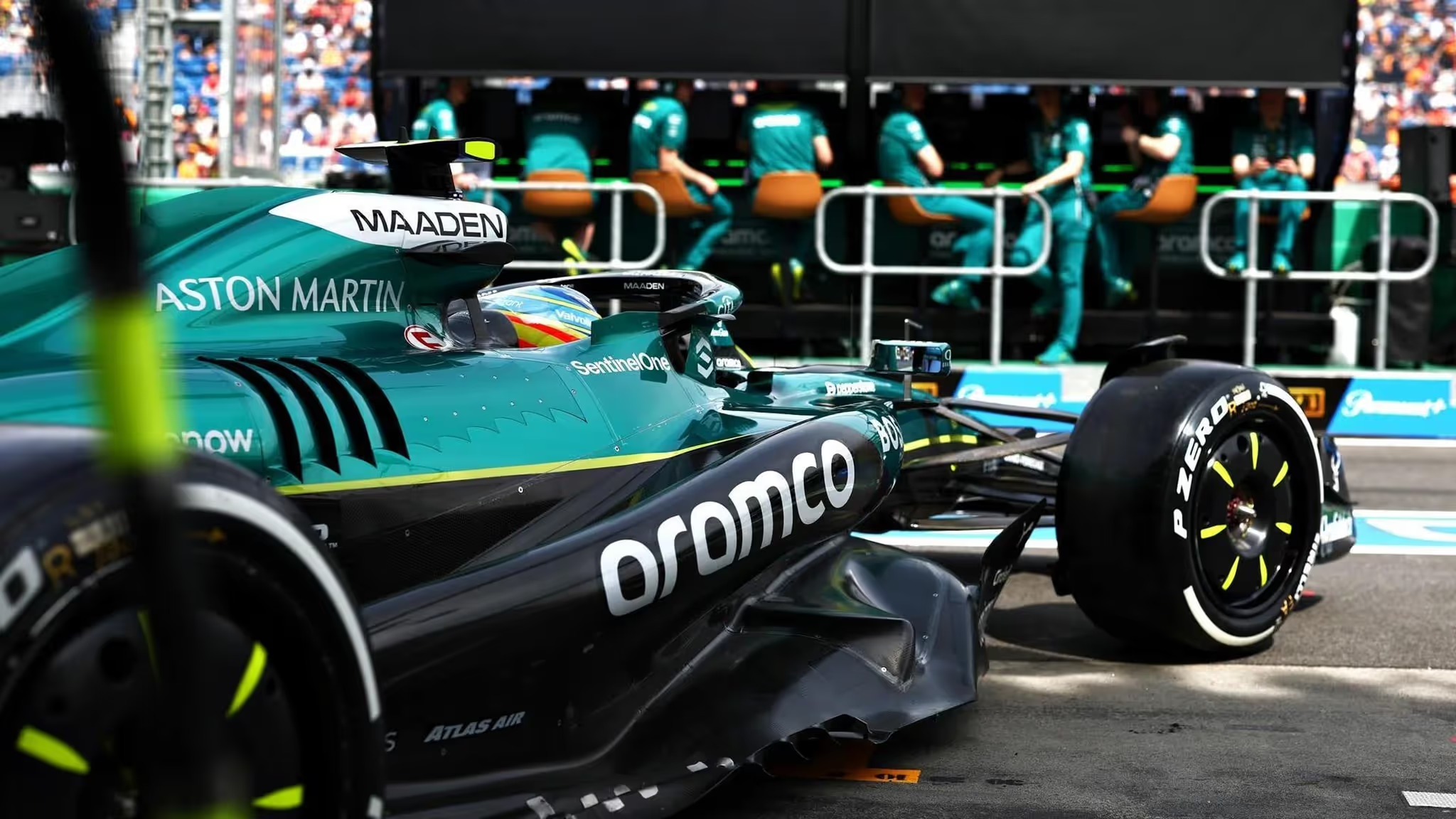
The Contenders: A New Era Begins
Opening races carry unpredictability. New regulations level hierarchies. Pre-season testing offers clues but rarely certainty.
But 2026 carries an additional historic dimension: it marks the first 11-team grid in over a decade. For years, Formula 1 has operated with a ten-team cap. The expansion signals both commercial confidence and competitive evolution. More cars. More variables. Greater unpredictability.
The Defending Momentum
Lando Norris arrives in Melbourne as the winner of the dramatic 2025 season opener, a rain-soaked thriller that showcased his maturity under pressure. If momentum carries meaning, he begins 2026 with confidence.
The Home Hero
No narrative captures Australian hearts more than that of Oscar Piastri. The Melbourne-born driver seeks to become the first Australian to stand on the podium at home since 1985. Each appearance on Melbourne Walk, where fans gather hours before sessions for autographs and selfies, draws thunderous support.
In Albert Park, national pride is tangible.
Veterans in New Colours
The 2026 grid also tells a story of reshuffled experience. Lewis Hamilton enters his second season in Ferrari red, no longer an experiment but an expectation.
The arrival of Cadillac, backed by General Motors, completes the 11-team lineup and signals a bold American resurgence. The project is entrusted to seasoned hands, with Valtteri Bottas and Sergio Pérez slated to spearhead the programme.
New manufacturers. Established champions in unfamiliar liveries. A grid expanded both numerically and philosophically.
For purists, it is the dawn of a fascinating arms race.
Beyond the Asphalt: A Festival of Speed
The Melbourne Grand Prix is not confined to its circuit.
Lakeside Energy and Federation Square
The Lakeside Festival transforms Albert Park into a cultural arena, while the F1 Fan Festival at Federation Square brings the sport into the city’s heart. Headline acts including Rita Ora, Duke Dumont and Basement Jaxx ensure that when engines fall silent, amplifiers take over.
Local Flavour: St Kilda and the Melbourne Walk
A short distance from the circuit lies St Kilda, where beach culture meets bohemian cafés. On race mornings, drivers make their way along Melbourne Walk, pausing to greet supporters who have waited since dawn.
Here, Formula 1 feels less corporate and more communal.
Hospitality at Its Zenith
Within the Formula 1 Paddock Club and the Mercedes-AMG Silver Arrows Lounge, champagne flows and pit-lane views redefine proximity. It is here that many LLC clients are delivered directly to private entrances, stepping from chauffeur-driven luxury into motorsport’s inner sanctum.


Technical Sidebar: The Walker Straight Revolution
On the Walker Straight, watch closely. As drivers exit Turn 14 in Z-Mode, wings sit steeply angled for maximum traction.
Midway down the straight, the shape-shifting begins. Flaps flatten. Drag reduces by as much as 55 per cent as the car transitions into X-Mode.
If a challenger is within one second, they will trigger the Manual Override, unleashing a surge of 350kW electrical power. The hunt for the lead becomes a high-speed game of energy management, timing and nerve.
Unlike the binary nature of DRS, active aerodynamics and electrical deployment operate as an integrated system. The car is no longer static in form; it adapts corner by corner, straight by straight.
For engineers, it is a data-rich frontier. For spectators, it is the future unfolding in real time.
A City Transformed
For four days in March, Melbourne changes character. Tramlines hum with anticipation. Corporate banners flutter along St Kilda Road. Albert Park Lake reflects both blue sky and carbon-fibre ambition.
The 2026 Melbourne Grand Prix represents a convergence of heritage and horizon. Parkland beauty frames machines at the cutting edge of sustainable performance. Local pride meets global spectacle. History greets reinvention.
As the lights go out beneath the southern sun, one truth becomes evident: this is more than an opening round. It is a statement of intent.
In Melbourne, every turn of the wheel is history in the making.
Contact us
