
The Inner Circle

A Survey of the World’s Most Influential Private Member Clubs and the Hidden Structures That Sustain Them
Private member clubs have never existed primarily to entertain; at their highest level, they exist to stabilise power. Long before “luxury” became a marketing term, these institutions emerged as controlled environments where influence could be exercised quietly, reputations assessed accurately, and continuity maintained across generations. They were designed not for novelty, but for permanence.
In an era of total visibility and permanent reputational risk, these clubs have evolved into nodes within a wider, largely invisible ecosystem. Frictionless access and behavioural discretion are no longer ancillary considerations, they are structural requirements. This survey examines these institutions not as lifestyle venues, but as the quiet infrastructure of global influence.
5 Hertford Street, London

The Counter-Revolution of Discretion
Founded in 2012 by Robin Birley, 5 Hertford Street was born from a specific cultural observation: the “democratisation” of London’s social scene had destroyed the one thing the elite valued most: privacy. Birley envisioned a club where behavioural consistency mattered more than notoriety.
- The Atmosphere: Housed within a 17th-century Shepherd Market townhouse, the club is a labyrinth of pattern-on-pattern fabrics, low ceilings, and roaring fires. It feels like a lived-in country house that happens to be at the heart of the world’s financial capital.
- The Clientele: A volatile mix of British royalty, senior politicians (the architects of Brexit are famously regular), and the “old guard” of Mayfair. It is arguably the most politically influential room in the UK.
- Operational Reality: The club’s power lies in its “Institutional Memory”. Staff operate with a continuity that ensures a member’s preferences, and guests, are never broadcast. LLC ensures that high-profile arrivals at this inconspicuous door do not create a predictable “stakeout” opportunity, utilising non-repetitive ground movement to mask the presence of the elite.
Annabel’s, London

Social Theatre and the Management of Visibility
Established in 1963 by Mark Birley and later acquired by Richard Caring, Annabel’s is the only nightclub Queen Elizabeth II was ever known to visit. It occupies a unique position: a stage where glamour and power coexist safely. Its modern incarnation in Berkeley Square is a maximalist palace designed to absorb attention inward.
- The Atmosphere: Maximalist and theatrical. From the pink onyx bathrooms to the hand-painted murals, it is designed to be a spectacle. However, this spectacle is an inward-facing diversion, allowing members to participate in “Social Theatre” without surrendering control to the outside world.
- The Clientele: Where 5 Hertford Street is for the “Establishment”, Annabel’s is for the "Visible”. It attracts fashion titans, global entrepreneurs, and the descendants of the original 1960s jet set.
- Operational Reality: Logistics focus on the “Clean Exit”. LLC coordinates departures with surgical timing to ensure the individual’s transition from the “theatre” of the club back to the public sphere is unremarked and secure.
CORE: Club, New York & Milan

The Architecture of Ideas
Founded in 2005 by Jennie Enterprise, CORE was a direct challenge to the “stuffy” Old World club model. It was designed for the “relentlessly curious”, the New York elite who found the mahogany-and-oil-painting vibe of the University Club too stagnant.
- The Atmosphere: Modern, minimalist, and curated. The Fifth Avenue flagship feels like a high-end gallery. It is built for work as much as play, featuring “intellectual programming” that rivals global think-tanks.
- The Clientele: The “New Power” of Manhattan, hedge fund principals, tech founders, and cultural provocateurs.
- Operational Reality: CORE members are often in a state of high-velocity transit. LLC acts as the “connective tissue”, managing transitions from private aviation hubs (Teterboro) to Midtown boardrooms, ensuring momentum is never interrupted by urban friction.
Yellowstone Club, Montana

Geography as a Security Feature
The Yellowstone Club (est. 1997) is the world’s only private ski and golf community. It is a “structural” solution to privacy: if you own a home here, the 15,000 acres of Montana wilderness are yours to share with only 900 other families
- The Atmosphere: Luxury defined by absence. There are no lift lines, no crowds, and no “day-trippers”. It is a gated community on a mountain-wide scale.
- The Clientele: Silicon Valley’s heavy hitters (Bill Gates, Eric Schmidt), entertainment moguls, and families seeking a return to “rugged” anonymity.
- Operational Reality: Reaching the club is a logistical feat involving private aviation and specialised ground transport through weather-heavy passes. LLC provides the “Mountain Logistics” layer, ensuring the transition from a Gulfstream at Bozeman to the club’s base lodge is a seamless, climate-controlled experience.
Yacht Club de Monaco

Maritime Power and Soft Diplomacy
Founded in 1953 by Prince Rainier III, the YCM was never just a sports club; it was a diplomatic tool to position Monaco as the “World Capital of Yachting”. Under Prince Albert II, it has become a headquarters for environmental ocean advocacy and the ultimate networking node for the world’s superyacht owners.
- The Atmosphere: The Norman Foster-designed clubhouse resembles a docked ship overlooking Port Hercules. It is formal, ceremonial, and deeply rooted in maritime protocol.
- The Clientele: A global “Who's Who” of industrialists, sovereign wealth managers, and the representation of over 80 nationalities.
- Operational Reality: During the Grand Prix or the Yacht Show, Monaco is a logistical bottleneck. LLC manages the complex “Multi-Modal” arrival, coordinating the handoff between helicopters, tenders, and secure ground transport.
The Arts Club, London & Dubai

The Intersection of Culture and Capital
Founded in 1863 by Charles Dickens and other luminaries, The Arts Club was intended to be a hub for those who shaped public thought. In 2011, it was revitalised by Gwyneth Paltrow and Gary Landesberg, blending its rich history with modern international influence.
- The Atmosphere: A sophisticated blend of 19th-century townhouse elegance and contemporary art. It is one of the few places where a Royal Academician might be seen dining next to a venture capitalist.
- The Clientele: The “Creative-Commercial” class. It attracts those who fund the arts as much as those who create them.
- Operational Reality: With the club’s expansion into Dubai, members now operate on a “Global Axis”. LLC supports this rhythm by managing the cross-border logistics, ensuring that the experience of moving between Dover Street and the DIFC is frictionless and consistent.
Silencio, Paris

The Subterranean Salon of the Avant-Garde
Conceived by filmmaker David Lynch and opened in 2011, Silencio is a physical manifestation of the director’s surrealist vision. Located six metres underground in the former printing rooms of L’Aurore, it is a “cultural incubator” rather than a traditional social club.
- The Atmosphere: Gold-leafed “ingot” walls, 1950s-style cinema seats, and an intimate stage. It is a space where the night is treated as a cultural stage.
- The Clientele: The global creative elite, Lynch, Pharrell Williams, and the fashion hierarchy of Paris. It is where intellectual authority converges away from the scrutiny of the paparazzi.
- Operational Reality: During Paris Fashion Week, the area becomes a focal point for the world’s media. LLC manages the “Last Mile” of access, utilising discreet subterranean entries to ensure a member’s arrival remains entirely off-the-record.
Capital Club, Dubai

Corporate Power as Infrastructure
Located within the DIFC, the Capital Club emerged alongside Dubai’s rise as a global financial centre. It is the premier business club for those operating at the intersection of capital and policy.
- The Atmosphere: High-stakes and highly functional. It is designed for the “Power Lunch” and the "Closed-Door Negotiation”, featuring sophisticated meeting rooms and private dining.
- The Clientele: Senior executives, sovereign wealth representatives, and policymakers.
- Operational Reality: In Dubai’s fast-moving corporate landscape, timing is everything. LLC provides protocol-aware logistics that align with volatile executive schedules, ensuring that movements are as efficient as they are discreet.
Roppongi Hills Club, Tokyo

Hierarchy, Ritual, and Corporate Order
Situated atop the Mori Tower, this club reflects the precision and prestige of Japanese corporate life. It offers 360-degree views of Tokyo, serving as a sanctuary above the world's most populous city.
- The Atmosphere: Formal, ritualistic, and governed by strict protocol. From the seating arrangements to the timing of service, every detail is a reflection of Japanese standards of excellence.
- The Clientele: The summit of Japanese industry, senior executives, diplomats, and international figures who understand the weight of tradition.
- Operational Reality: Cultural fluency is the “entry fee” here. LLC operates quietly within these expectations, aligning ground movement with Japan’s uncompromising standards of punctuality and respect.
Soho House, Global
The Networked Creative Class
What began in 1995 in London’s Greek Street has evolved under Nick Jones into a global empire. While more widespread than its contemporaries, Soho House remains the definitive club for the “Creative Class”.
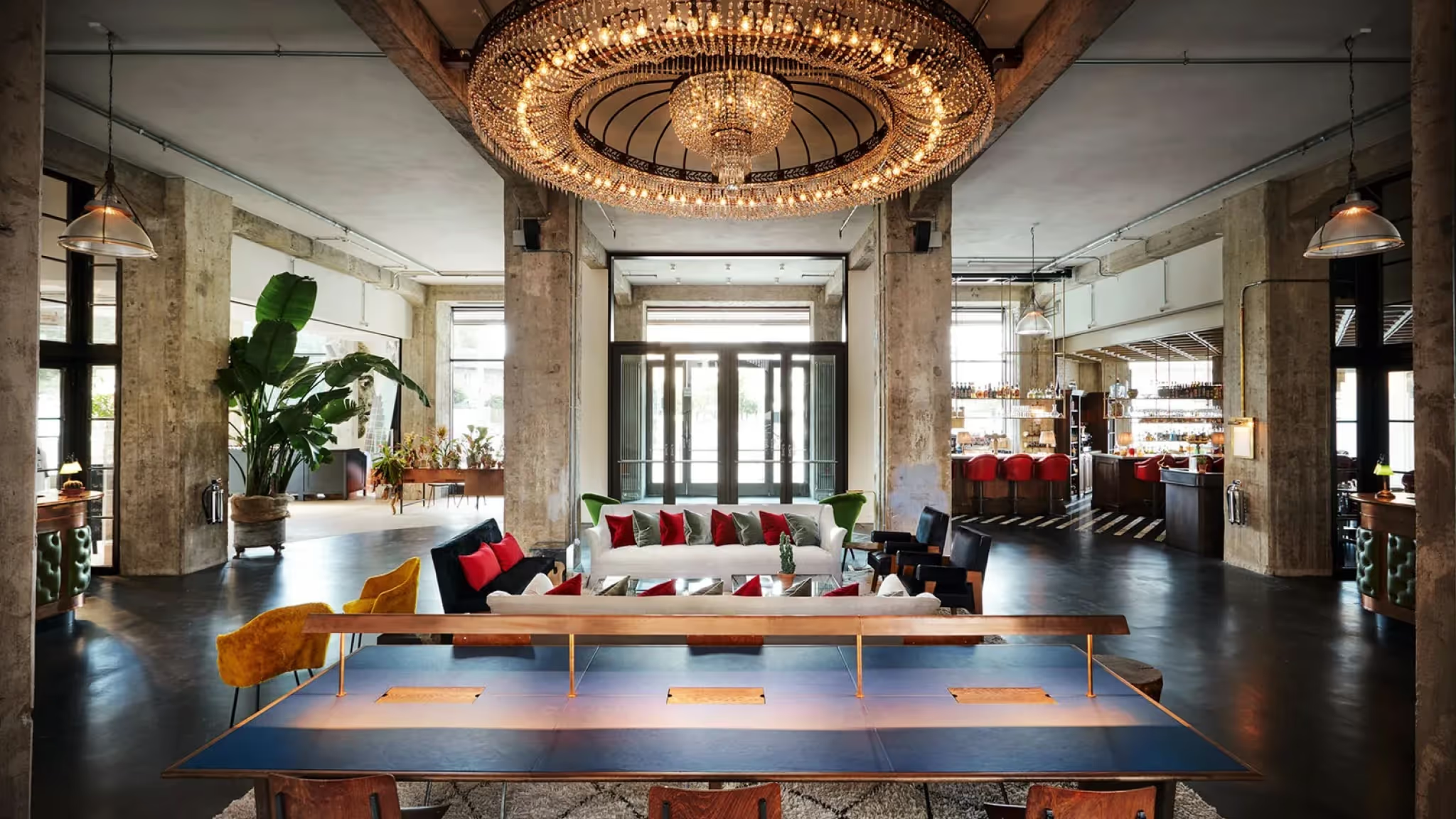
- The Atmosphere: Characterful, comfortable, and “domestic”. It is designed to feel like a "home away from home", with signature designs that remain consistent from London to Istanbul.
- The Clientele: Historically for "“Creatives” (media, fashion, art). It is the club that famously hosted the first date of the Duke and Duchess of Sussex.
- Operational Reality: The value here is networked continuity. A member moving between 180 House in London and Soho Warehouse in LA expects a zero-friction transition. LLC supports this by managing the “International Hand-off”, ensuring that personal security and transport remain consistent across continents.
The 1930 Club, Milan

The Discipline of Silence
The most secretive node in Europe, The 1930 Club is the definition of “if you know, you know”. It has no public address and requires an invitation from the founders of the Mag Café to even begin the vetting process.
- The Atmosphere: A perfect 1930s speakeasy, exposed brick, vintage armchairs, and an antique gramophone. It is a sanctuary for Milanese industrialists who value total anonymity.
- The Clientele: Generational Italian capital. It is a room where the most consequential decisions in Italian finance are made over a quiet drink
- Operational Reality: Milan’s ZTL (Limited Traffic Zones) create a digital trail. LLC utilises permit-agnostic strategies and non-traceable arrival routes to preserve the club’s defining condition: total invisibility.
The Mastery of the Sanctuary
The institutions profiled here represent the final “Analog Strongholds” in a data-driven world. They endure because they solve the modern elite's greatest paradox: that the more power one possesses, the more vulnerable one becomes to exposure.
True influence is now exercised in the “quiet spaces” between the noise of social media and the volatility of the markets. At this level, logistics are not a service; they are a safeguard. When the movement of a member is managed with the same precision as the club’s internal code of conduct, it creates the quiet illusion of effortlessness that defines true power.
For the “Global Alchemist”, the journey between these sanctuaries must be as refined as the destination itself. It is the invisible infrastructure of firms like LLC that allows these hidden structures to function, ensuring that the “Inner Circle” remains exactly that: protected, private, and permanent.

